

How a Plastic Profile Extrusion Die Design Impacts Its Performance
Plastic profile extrusion relies on a die that shapes molten polymer into a stable, repeatable form. The design of that die determines how the material flows, how the profile forms, and how consistently the final product meets dimensional requirements. When the plastic profile extrusion die design is engineered correctly, the process runs smoothly with predictable output and reduced scrap. When the design is off, issues such as distortion, uneven walls, and surface irregularities can appear, slowing production and increasing costs.
Key Takeaways: How a Plastic Profile Extrusion Die Design Impacts Its Performance
- Flow balance drives profile stability — Even melt distribution reduces distortion and dimensional variation.
- Die geometry shapes accuracy — Land lengths and channel widths influence how the profile forms.
- Material behavior matters — Melt viscosity and strength must align with channel design.
- Cooling interaction affects consistency — Uniform exit conditions support stable calibration.
- Surface quality depends on internal finish — Smooth flow paths help prevent marks and irregularities.
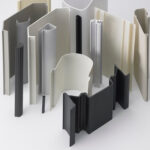 Flow Behavior Inside the Die
Polymer melt must move through the die in a controlled, balanced manner. Flow channels guide the material toward the exit, and their shape influences pressure, velocity, and temperature distribution. If the melt encounters abrupt transitions or imbalanced paths, it can create areas of high pressure or restricted movement. These conditions often lead to distortion or dimensional variation. Balanced flow paths help maintain uniform movement, supporting stable formation as the material exits the die.
Plastic Profile Extrusion Die Design Accuracy
Die geometry directly affects the final shape of the extruded profile. Land lengths, channel widths, and internal transitions all influence how the polymer forms. Longer lands help stabilize the melt before exit, while shorter lands may increase sensitivity to pressure changes. The geometry must match the intended profile design so the material forms correctly without excessive stress. Consistent geometry supports repeatability, allowing the same die to produce identical parts across multiple runs.
Material Behavior and Melt Characteristics
Different polymers respond differently to pressure, temperature, and flow conditions. Melt viscosity, melt strength, and cooling behavior all influence how the material moves through the die. A die designed for one resin may not perform well with another. Understanding these characteristics helps engineers adjust channel dimensions, land lengths, and flow balancing features. When the die design aligns with the material’s behavior, extrusion becomes more predictable and stable.
Cooling and Calibration Interaction
The die design must work in coordination with downstream cooling and calibration equipment. If the profile exits the die with uneven temperature distribution, cooling may exaggerate distortions or create dimensional variation. A well-designed die helps the profile exit with uniform temperature and shape, allowing calibration tools to stabilize the form effectively. This interaction supports consistent wall thickness, straightness, and overall dimensional accuracy.
Surface Quality and Defect Prevention
Surface finish is influenced by how smoothly the polymer flows through the die. Rough internal surfaces, abrupt transitions, or poorly balanced flow paths can create marks or irregularities on the profile exterior. Proper polishing, streamlined geometry, and balanced flow help reduce friction and turbulence. These improvements support smoother surfaces and reduce the chance of defects such as drag lines or melt fractures.
Design Elements That Influence Extrusion Performance
- Flow channel layout — Determines how evenly the melt distributes across the profile.
- Land length selection — Influences stability and dimensional consistency at the die exit.
- Internal surface finish — Helps reduce friction and prevent surface defects.
- Transition geometry — Smooth transitions support stable melt movement.
- Material specific adjustments — Ensures the die matches the melt behavior of the chosen polymer.
- Cooling compatibility — Supports uniform temperature distribution for downstream calibration.
 Maintenance and Longevity
A well-designed die is easier to maintain and lasts longer. Smooth internal surfaces reduce buildup, while accessible components simplify cleaning and inspection. Dies with predictable flow behavior also experience less wear, supporting longer service life. Regular maintenance combined with a stable design helps ensure consistent performance over time.
Get Started on Your Plastic Profile Extrusion Die Design
A plastic profile extrusion die is the foundation of process stability, dimensional accuracy, and long term production efficiency. When the die design aligns with material behavior, flow requirements, and downstream cooling, manufacturers achieve consistent output and reduced downtime.
If your extrusion process needs improved stability, better dimensional control, or evaluation of die performance, Northland Plastics can help you identify design improvements that support reliable, repeatable production.

Key Variables That Influence Profile Extrusion Quality
A plastic profile extrusion is a continuous, shaped component produced on an extrusion line, and its quality depends on precise control of material behavior, die engineering, cooling, and downstream handling. When these variables are aligned, manufacturers achieve consistent dimensions, stable mechanical properties, and repeatable surface quality. When they drift, even slightly, defects such as bowing, twist, sink, chatter, or inconsistent wall thickness can appear. Understanding the key factors that influence profile extrusion quality helps engineers and production teams maintain stable output across long runs, multiple materials, and complex geometries.
The variables below determine how reliably an extrusion line performs and how consistently each plastic profile extrusion meets specification.
Key Takeaways: Key Variables That Influence Profile Extrusion Quality
- Material consistency and melt behavior strongly influence dimensional accuracy and surface quality.
- Die design and thermal uniformity determine how reliably the profile forms as it exits the tooling.
- Cooling, calibration, and puller control have the greatest impact on straightness, wall uniformity, and long run stability.
- Inline measurement and stable operating conditions help maintain tolerance and reduce scrap across extended production runs.
1. Profile Extrusion Material Selection and Melt Behavior
The polymer used to produce a plastic profile extrusion plays a central role in dimensional stability and surface finish. Melt viscosity, melt strength, and thermal sensitivity determine how the material fills the die and how it behaves during cooling.
Key considerations include:
- Rheology: Materials with stable viscosity profiles produce more predictable flow through complex dies.
- Additives: UV stabilizers, impact modifiers, lubricants, and colorants can alter melt flow and cooling behavior.
- Moisture content: Hygroscopic materials (e.g., nylon, PETG) require proper drying to prevent bubbles, splay, or voids.
Material consistency is one of the strongest predictors of repeatable profile quality.
2. Die Design and Flow Distribution
The extrusion die shapes the molten polymer into the final profile geometry, making it one of the most influential components in determining part quality.
Important die related factors include:
- Flow balance: Uneven flow causes warpage, twist, or dimensional drift in the finished profile.
- Land length: Longer lands improve dimensional control but increase backpressure.
- Die swell: Materials expand differently upon exiting the die, requiring compensation in die geometry.
- Thermal uniformity: Hot or cold spots in the die create inconsistent wall thickness.
A well designed die reduces downstream corrections and stabilizes the entire line.
3. Cooling, Calibration, and Vacuum Sizing
Once the molten polymer exits the die and becomes a plastic profile extrusion, cooling determines how quickly the shape stabilizes. Improper cooling is a leading cause of dimensional variation.
Key cooling variables include:
- Water temperature: Too warm and the profile distorts; too cold and internal stresses increase.
- Vacuum calibration: Holds the profile against sizing tools so it maintains its intended shape.
- Spray vs. immersion: Different geometries require different cooling strategies.
Consistent cooling is essential for maintaining straightness, flatness, and wall uniformity.
4. Puller Speed and Downstream Tension
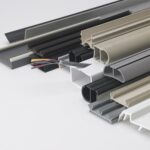 The puller controls line speed and tension, directly affecting the dimensions of each plastic profile extrusion.
Important factors:
- Speed stability: Even minor fluctuations cause thickness variation.
- Grip pressure: Too much pressure distorts the profile; too little causes slippage.
- Synchronization: Puller speed must match extruder output to avoid stretching or compression.
Puller control is one of the most overlooked contributors to profile quality.
5. Environmental and Operational Stability
Extrusion lines are sensitive to external conditions that indirectly affect the finished profile.
Influential environmental factors include:
- Ambient temperature: Affects cooling rate and material behavior.
- Humidity: Impacts hygroscopic materials and static buildup.
- Operator adjustments: Frequent manual changes introduce variability.
Stable operating conditions support predictable profile quality.
6. Inline Measurement and Quality Monitoring
Modern extrusion lines rely on real time measurement to keep plastic profile extrusions within tolerance.
Common tools include:
- Laser micrometers for dimensional accuracy
- Capacitance gauges for wall thickness
- Vision systems for surface inspection
Inline monitoring reduces scrap and improves repeatability across long runs.
Start Your Plastic Profile Extrusion Project
The quality of a plastic profile extrusion is shaped by controlled material behavior, precise die engineering, stable cooling, and consistent downstream handling. When these variables are optimized together, manufacturers achieve predictable performance, reduced scrap, and reliable dimensional accuracy.
If you’re looking to improve the consistency, throughput, or dimensional control of your plastic profile extrusions, our team can help evaluate your material, tooling, and downstream setup. We support OEMs and manufacturers with process guidance, design considerations, and production ready solutions tailored to complex profiles and demanding applications. Contact us today to discuss your requirements or request a technical review of your current extrusion line.